
From PoC to Production
The AI Implementation Gap
24th July
3 mins
BLOG
The allure of AI is undeniable. PoCs have captured the imagination of businesses and the public alike, showcasing transformative capabilities across industries. However, the journey from a successful PoC to a fully operational AI system is HARD. This "Production Purgatory" is characterized by an inability to capture the value promised due to a stark contrast between the controlled environment of a demo and the chaotic reality of real-world deployment.
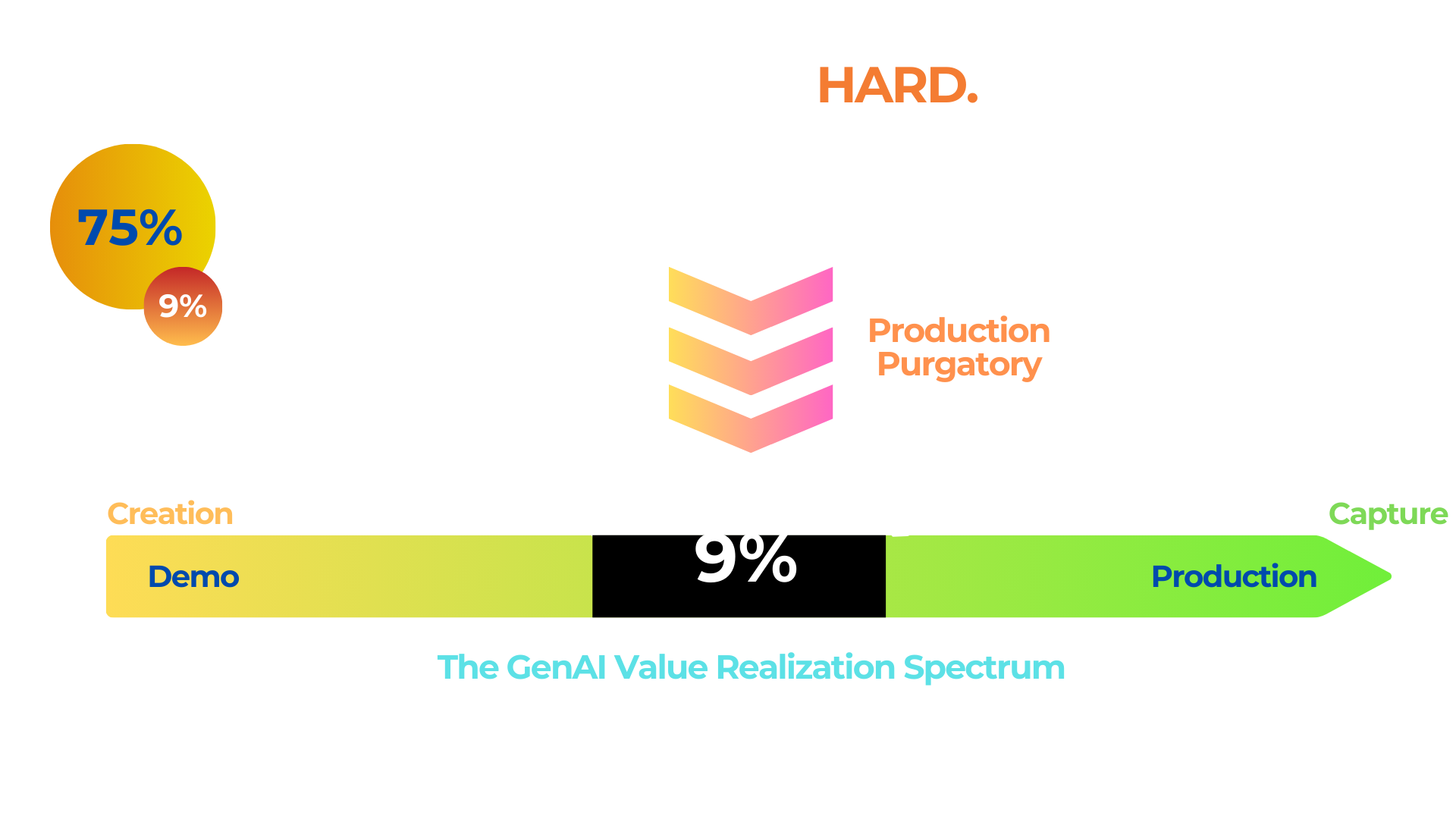
The Value Realization Spectrum
The value realization spectrum illustrates the progression of an AI project from its conceptual stages through to full production deployment and ongoing optimization.
- Value Creation at the Demo Stage
- Production Purgatory
- Value Capture at the Production Stage
Organizations that fail to reach stage 3 in any capacity see no value capture, consequently finding themselves disillusioned - unable to show any ROI after years of investing.****
So why do companies end up in purgatory? What is so different between demo and prod?
Navigating the Demo vs Prod chasm: The Differences
The following are the three critical areas where AI systems encounter the most pressing issues when transitioning from demo to production.
"Just Doesn't Work": Scaling & Cost Hurdles
Scale exposes hidden flaws in AI systems. What seems trivial in demos often snowballs into major roadblocks in production. As data dimensions expand and traffic surges, performance degrades and costs skyrocket, potentially derailing launches.
Data Dimension Expansion
A demo of a chatbot may involve a RAG implementation on manageable data chunks such as a single-page PDF or a few different PDFs in total. While retrieval works reasonably well on such a small sample space, production environments may present an entirely different scale, such as an enterprise knowledge repository across a few thousand PDFs or 500 page PDFs. Architects from software backgrounds tend to take scaling unit success for granted (as holds largely true in software), but in AI, this difference fundamentally changes how such systems must be designed, implemented and optimized.
Throughput Limits & Costs
Most 3rd party APIs have associated rate limits, an issue that might occasionally cause an error in demos but truly comes to the forefront once products are released to production. Also, in demos, individual request costs tend to be rounding errors on balance sheets. Neither of these hold true in production - most systems struggle to handle high volume concurrent requests, and have to constrain users for cost-reasons.
Dynamic Adaptation
Static systems struggle to survive in production's dynamic conditions. Production AI systems work with real-time or near-real-time data, multiple users across functions, geographies and systems - an environment significantly different from the controlled settings of the demo phase, where underlying information - like data stores, base models etc can be held constant.
"Works, But Unused": Adoption from Novelty to Necessity
Demos create a bubble of excitement where users willingly compromise - using standalone systems, accepting minor flaws, and waiting patiently. However, in production, this bubble bursts. Users snap back to Business-As-Usual, reverting to their ingrained behaviors and institutional expectations. The following set of problems emerge from that delta in demo flexibility and production rigidity, often leading to a critical adoption gap where even impressive AI systems struggle to gain traction.
Integration Challenges
The transition from demo to production environment reveals a crucial disparity in system integration. While demos are typically standalone and used in isolation, production AI systems must be seamlessly woven into existing workflows to ensure consistent usage. One significant hurdle is:
Prevailing System Integration: The adoption rate of AI tools skyrockets when they're embedded within familiar applications. For instance, an AI email generator integrated directly into an email client sees far higher usage than a separate, standalone tool. However, incorporating AI models into established enterprise systems is a complex necessity in production environments. This process can substantially decelerate deployment, introduce complications, or even completely halt AI implementation. The challenge often extends to designing and implementing intricate APIs that bridge modern AI capabilities with legacy infrastructure - a critical aspect rarely addressed in demo scenarios.
Reliability Over Raw Performance
In production, the focus shifts from showcasing capabilities to ensuring consistent performance.
As the saying goes, "in production you get paid to not fail, you don't get paid to succeed." In other words, the key word here is certainty, i.e. Your AI can do fewer things, but it needs to do them well and with extremely high consistency, and fail gracefully. This is a significantly different objective from most demos, which focus on achieving the most impressive outcomes on select use-cases. Furthermore, 'Model Drift' can generate erroneous outputs, impacting enterprise-scale performance and reliability.
Sensitivity to Latency
An AI system achieving 95% accuracy with a 30-second wait might impress in a demo (or in some cases, be artifically sped up in recorded videos), but in production, every millisecond counts. Most users exist in worlds with lightning fast UX. For example, Amazon found that a mere 100ms increase in latency translated to a 1% drop in sales, underscoring the critical nature of performance and latency in production environments.
"Works, Can't Use Despite Need": Governance Gridlock
Enterprises often underestimate governance challenges in AI deployment. Issues like Role-Based Access Control (RBAC), data governance, and compliance are frequently scoped out during demos, assumed to have tractable solutions. In production, these become critical roadblocks, hindering full implementation and value realization.
Data Management & Governance
While demos often use dummy data, production systems can't ignore data management or governance and must expose live user data to AI applications. Sharing of sensitive information, such as PII, internal data, and customer-specific data, poses significant risks, especially as these data sets are integrated into public LLMs that may record and use prompts for future training, exposing enterprises to unintentional leakage through model outputs. This can lead to legal issues, privacy breaches, financial penalties, and reputational damage.
Regulatory Compliance
The regulatory landscape for AI systems is complex and ever-evolving. Regulations like GDPR and CCPA impose strict requirements on data handling and user privacy. During demos, these are left out of planning entirely, and as such, systems are architected in a fundamentally violative manner. The stakes are high—non-compliance can result in fines up to 4% of global turnover.
Role-Based Access Control (RBAC) Challenges
RBAC challenges include defining precise, dynamic roles and permissions across diverse teams and environments, while ensuring duty segregation (to prevent conflicts of interest), data privacy, and compliance. The complexities escalate in tandem with scaling, requiring integration with existing systems, accommodation of AI updates, and extension of version control and APIs. These potential security risks necessitate audit trails and real-time monitoring early-on, and thus, RBAC should be a key consideration from Day 1.
Conclusion
As you chart your own course in AI implementation, it is crucial to anticipate enterprise-scale challenges that extend beyond technical hurdles. To successfully navigate this transition:
- Plan for scale from the outset, considering data dimensions, throughput, and costs.
- Prioritize seamless integration with existing workflows to drive adoption.
- Balance innovation with reliability and consistent performance.
- Address governance, compliance, and data management proactively.
By building robust strategies to address these challenges, businesses can move beyond demos and prototypes to realize the true transformative potential of AI in production environments.
© 2026 Emissary. All rights reserved.