
The AI Gold Rush
How Software Giants Became the Dinosaurs They Disrupted
20th Oct
2min
BLOG
The irony is almost too perfect. Software companies that spent decades relegating traditional industries to irrelevance are now frantically rushing to avoid the same fate - bolting AI features onto their products with all the grace of a dinosaur wearing rollerblades. The very companies that preached "software is eating the world" are discovering that AI doesn't care much for their legacy code—or their business models. In a world where AI-native companies race towards eating labor budgets, software augmenting existing roles is finding few buyers - with stock prices reflecting a steady death march all too familiar to the Xerox’s and Kodak’s of the days gone by.
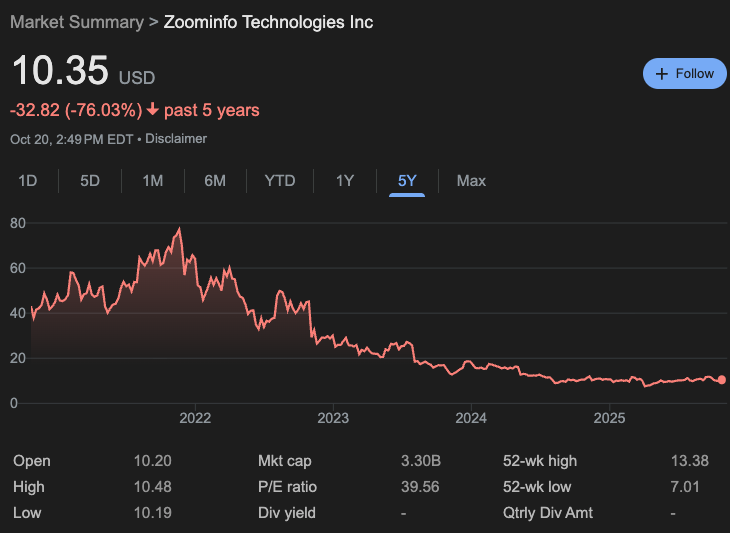
Just like the past wave claimed to have a well thought out ‘digital strategy’, every software company claims to have one for AI. But walk through any SaaS product today and you'll find the same desperate pattern: a "Copilot" awkwardly shoehorned into the interface, promising to revolutionize your workflow while delivering little more than glorified autocomplete. It's the 2025 equivalent of the "there's an app for that" era, when companies added mobile apps not because users needed them, but because boardrooms demanded them. The result? Thousands of useless apps nobody downloaded. Today's equivalent? Thousands of AI features nobody enables, trusts, or values.
The economics illustrate this brutal truth. Even Microsoft and Google, with their massive fleet of ML research talent, have had to force AI features into their base plans, charging only a few incremental dollars per month without any opt-out after failing to generate sufficient adoption during an initial opt-in period. Instead of creating true value, the behemoths have been forced to use their existing lock-in and pricing power to make it look like they're leading the AI revolution. Its defensive strategy masquerading as innovation. But smaller players face an even grimmer reality. Without Microsoft's enterprise stranglehold, they're being compelled to give away AI features far below cost, desperately hoping to maintain relevance in a world passing them by. The same companies that charged premium prices for basic CRUD operations as systems of record are now hemorrhaging money on LLMs, offering "AI-powered" features that users neither requested nor needed. They're trapped in a race to the bottom, competing on a dimension where they have no sustainable advantage - with no clear long-term strategy.
This scramble mirrors exactly what software companies mocked their predecessors for: reactive, superficial adoption of new technology without reimagining the core business. Remember when every brick-and-mortar retailer launched a mediocre website? When every company built a mobile app that was just their desktop site crammed into a smaller screen? That's today's "AI integration" playbook.
But there are exceptions—companies that understand AI isn't a feature, it's a foundation. Handshake, the college recruiting platform, didn't just add an AI chatbot. They understood that their talent network could power AI’s thirst for expertise - and leveraged that insight into $100M+ revenue in <1 year. Workday, while still far away from enacting a true transformation, has shown an initial willingness to go all-in on being a system of action with their recent blockbuster acquisitions of Paradox and Sanas - targeting labor budgets.
Companies like these recognize what the incumbents are missing: AI isn't a feature enhancement, it's an architectural shift. You can't sprinkle it on top like seasoning. You have to rebuild the meal. To command any meaningful pricing power, software companies will have to bet on transforming one or more of the three channels of AI - building systems of action (like Cursor, Decagon, Harvey), building the models that power them (like OpenAI, Voyage AI, ElevenLabs) or the building the pipes that feed the models - data (Mercor, Handshake) and compute (Coreweave, Lambda). And overcoming the inertia of existing revenue is going to be the largest existential risk to overcome in the process.
What doesn’t innovate, becomes history. In the grand scheme of things, this might be the first real challenge of true obsolescence the software industry has faced. By every measure, it’s still (very) early days - the outcomes haven’t even started being written. But for the moment, the dinosaurs have become what they once slayed: slow-moving incumbents adding superficial innovation while nimbler competitors rebuild from first principles.
© 2026 Emissary. All rights reserved.