
The AI Maturity journey
From AI Curious to AI-Enabled and finally, AI-Native
21st Jun
3 mins
BLOG
AI is a transformative force in modern business already redefining competitive landscapes. However, this redefinition has also transposed itself into how organizations plan strategically to fully integrate AI into their DNA.
We have observed that this organizational journey is typically defined by three evolutionary paradigms or stages of tactical maturity: AI Curious, AI-Enabled, and AI-Native.
And thus, we've outlined the complex AI Maturity journey, each stage's key characteristics, the challenges faced, and our recommendations on how ambitious, innovative organizations can accelerate this process.
AI Curious: The Foundation of AI Awareness (What could we use AI for?)
"AI Curious" represents the initial exploration of incumbents, where both organizations and their curious employees work with tools such as ChatGPT. The primary goal here is characterized by experimentation with prompts and responses, as businesses gain fundamental insights into the potential of GenAI and its applications.
Key Characteristics:
- Exploration and Learning: Employees explore how GenAI can assist in tasks such as content creation, data analysis, and customer interaction. While teams build the foundational-knowledge muscle, this phase is characterized by the collective visualization and imagination of possibilities with AI. Teams dream of the technological paradigm shifts that could usher in new ways of doing business!
- Ad-Hoc Implementations: These are isolated projects where AI is used in specific scenarios without a strategic plan. For example, an employee on the marketing team might use ChatGPT or an online AI tool to generate content ideas, or one on a customer service team might experiment with AI-powered chatbots to handle basic queries. These efforts are typically not integrated into the broader business processes and are conducted in silos.
- Limited Integration: Again, AI tools are not yet embedded into the core operations of the business. The use of AI is experimental, and there is limited integration with existing systems. The data used for these AI experiments might be scattered across various departments, leading to challenges in data management and quality.
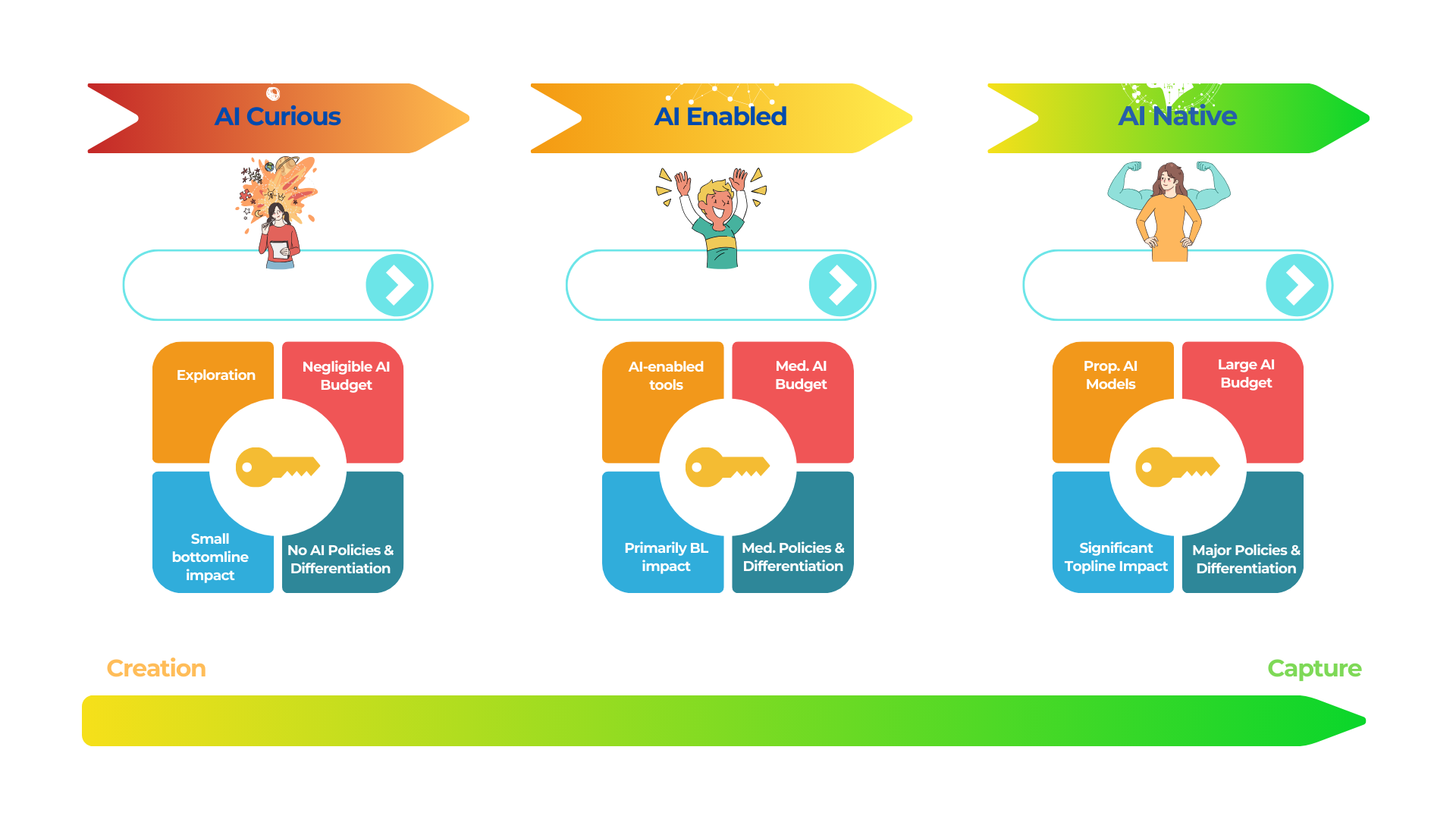
- AI Value Realization Spectrum: We believe that extraction of value from AI is spread across a wide spectrum that we call the AI Value Realization Spectrum. AI Curious companies are in the "Value Creation" band. Here, there is little to some impact on internal efficiencies and thus bottom line, but zero impact on top-line growth.
- AI Policies: Companies do not have robust internal guidelines or policies on AI deployment, governance and usage.
- AI Differentiation: Fairly generic AI deployments with little to no differentiation or customization.
- AI Budget: Still in the early stages of AI experimentation, companies have a limited, usually experimental, budget.
Challenges:
- Lack of Expertise: Limited understanding of AI technologies and their potential.
- Isolated, Uncoordinated Efforts: AI projects are not part of a broader strategic plan.
- Data Silos: Data required for AI projects may be scattered and unstructured.
Overcoming these challenges requires building a strong foundation of AI knowledge and understanding the broader implications of AI for business.
Transition to AI-Enabled: Embedding AI into Operations (What should we use AI for?)
As organizations continue to visualize institutional change and get excited about the prospects of AI, they move to the AI-Enabled stage. Here, companies begin to embed AI more formally into their operations, strategically deploying enterprise-grade solutions leveraging boilerplate open-source or third-party AI models to address specific business problems.
Key Characteristics:
- AI-enabled Tools & Solutions: At this stage, companies begin to make strategic decisions on AI-enabled tools and solutions investments to get the right technological support to successfully build AI models.
- Strategic Projects for Operational Integration: Companies identify specific business cases and map use cases where AI models can add value or solve cross-functional problems. For example, a retail company might use AI for demand forecasting, while a financial services firm might implement AI for fraud detection.
- Adoption of 3rd Party LLMs: Large Language Models become integral to AI-enabled organizations. These models are used to automate tasks, enhance decision-making, and improve efficiency. For instance, LLMs can generate reports, provide insights from large datasets, and assist in customer service by understanding and responding to complex queries.
- Data Integration: Efforts are made to consolidate and more importantly, harness data from various sources to support AI projects. This involves creating a centralized data infrastructure where data is cleaned, structured, and made accessible for AI model training and deployment.
- Performance Metrics: Success metrics and KPIs are established to measure the business or dollar impact of AI initiatives.
- AI Value Realization Spectrum: AI-enabled companies are somewhere between 'Value Creation' and complete 'Value Capture' in the spectrum. Value generated is primarily internal facing operational efficiency, and thus the impact is entirely on the bottom line.
- Other Characteristics: Just as the case with Value Realization - AI Policies, AI Differentiation, and AI Budgets are somewhere in the mid-way in their institutional development and evolution.
Challenges:
- Scalability: Scaling AI projects from pilot to production is HARD. Organizations must ensure that their AI models are robust, reliable, and capable of handling real-world, production-ready, and enterprise-grade deployment.
- Data Quality: Ensuring high-quality, clean, and relevant data for AI models.
- Change Management: Managing organizational change and employee adaptation to AI-driven processes.
- Fear of AI vs Fact: While organizations can visualize the potential impact of AI and are significantly excited, they do not yet have the confidence of an AI-Native company, i.e. Fear of AI peaks at this stage. Companies are still trying to figure out the impact of AI on operational and strategic mandates, along with its impact on administrative mechanisms.
- Top Line vs Bottom Line: Again, lack of top line impact is KEY here. Precisely why organizations at this stage aspire to move to the AI-Native stage ASAP to capture the real value of AI deployments.
Finally, AI-Native: AI as the Organizational DNA (How can we make AI ROI-positive?)
The final stage, AI-Native, is where AI becomes an integral part of the organization's fabric. Its beating heart. The initial visualization, and the later stage excitement evolves to quiet, institutional confidence. Companies in this stage have or begin acquiring the building blocks including requisite infrastructural scaffolding to start developing their own AI models, eventually owning a fleet of proprietary, fine-tuned models that are hyper-aligned with their specific business requirements. AI-driven insights, automation, and even decision-making are embedded into every aspect of the business, driving continuous innovation and improvement. In fact, this fleet of models metamorphizes into an extended workforce, enabling a future where every current employee becomes a supervisor managing task-specific, workflow-augmenting intelligent bots.
Key Characteristics:
- Proprietary AI Models: Proprietary models are designed to address specific business challenges and are continuously fine-tuned to ensure optimal performance. For example, an e-commerce company might use a proprietary recommendation engine to personalize customer experiences and increase sales.
- Continuous Improvement: Models are continuously retrained and iterated to maintain accuracy and relevance. This involves monitoring model performance, identifying drifts, and updating models based on new data and feedback. Continuous improvement ensures that AI systems remain effective and aligned with evolving business needs.
- End-to-End Integration: AI is seamlessly integrated into all business processes, enabling organizations to leverage AI for decision-making, process automation, and innovation, thus supercharging top-line and bottom-line growth.
- AI Value Realization Spectrum: At this stage, companies are in the "Value Capture" band, maximizing the true benefits of AI! These deployed AI capabilities bring about external-facing financial impact, significantly transforming top-line economics.
- AI Policies: Companies have an appointed AI Governance and Policy committee by this stage, with robust AI Policies and usage guardrails in place.
- AI Differentiation: Contingent on their unique existing distributions and corresponding deployment, the AI is hyperaligned to business needs. Companies at this stage will have a comprehensive grasp on the 3 Cs of AI deployment -
- Control
- Customization
- Cost of serving
- AI Budget: Given the visible economic impact, companies at this stage have a large institutional budget to continue to expand AI capabilities.
Challenges:
- Maintaining Accuracy: Regular retraining and fine-tuning of models to avoid drift and maintain performance.
- Legislative Considerations: Addressing required AI-related laws and rules sufficiently
- Sustained Investment: Continuous investment in AI talent, technology, and infrastructure.
Recommendations on how to achieve AI Maturity
- Building a Strong Data Foundation: Organizations must focus on building a robust data infrastructure, the backbone of any AI initiative, supported by effective data governance policies and practices.
- Fostering Safe Innovation: Creating free 'experimentation' and 'innovation' institutional harnesses, i.e. an open, collaborative sandbox with technological enablers and guardrails that organizations create to encourage employees to explore AI technologies and propose new ideas. This culture of assisted-innovation supercharges AI assimilation and deployment.
- Implementing a Strategic AI Roadmap: A comprehensive AI strategy that aligns with the organization's overall business objectives is essential. This roadmap should outline key milestones, resource requirements, and success metrics. A strategic AI roadmap provides a clear direction for AI initiatives and ensures that they are aligned with the organization's long-term vision.
- Acquiring Genuine AI Talent: Talent acquisition needs a roadmap too to drive cutting-edge innovation and implementation. Identifying specific AI skills and roles needed, partnering with academic institutions, offering internships, and institutionalizing effective onboarding and retention programs should be key considerations and milestones.
- Upskilling Existing Talent: Investing in training and development programs is crucial for building a skilled AI workforce.
- Leveraging AI Infrastructure Platforms: Integrating an AI Infrastructure platform can provide the right scaffolding to streamline and accelerate model development, deployment, and maintenance.
For example, Emissary helps organizations automate model retraining, manage models in production, and continuously improve AI capabilities.
Visualizing the AI Maturity Journey
To illustrate the AI Maturity Journey, consider the following diagram:
Conclusion
The journey from AI Curious to AI-Native transforms organizations, driving innovation and growth through strategic vision, willingness for change, commitment, and continuous effort.
For AI-enabled companies aspiring to be AI-Native, Emissary offers the infrastructure and expertise to accelerate this transition. By automating model retraining, managing models in production, and continuously improving AI capabilities, Emissary helps innovative and ambitious organizations unlock the full potential of AI. Your path to an AI-driven future starts here!
© 2026 Emissary. All rights reserved.